
Hird elevates PASMA training with new mobile access towers

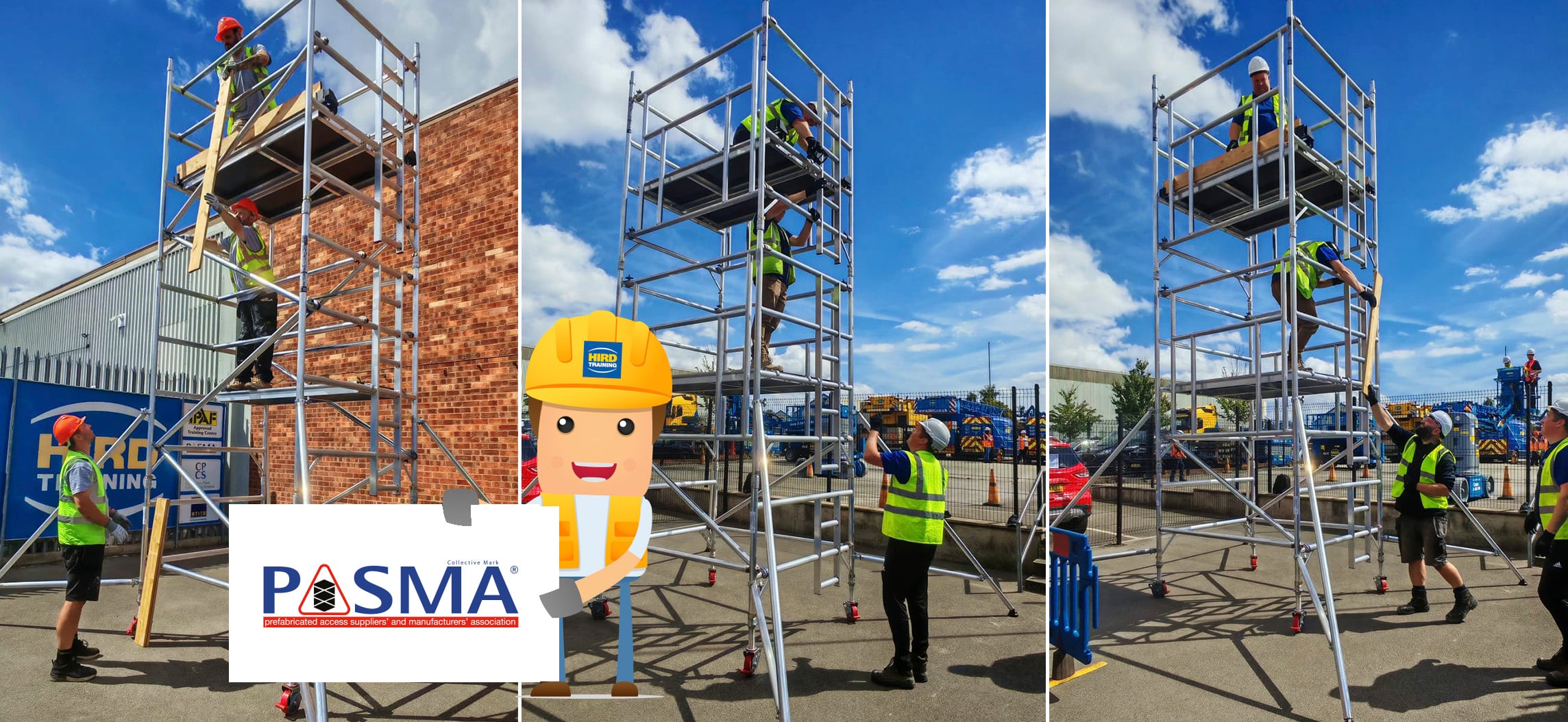
PASMA training at Hird has gone up in the world with a new set-up giving course candidates more time to practice the skills that will help keep them safe while working at height.
Hird Training’s facilities now feature two new mobile access towers that make it easier and more efficient to run PASMA courses so instructors can focus fully on key learning points.
One of the platforms is an advance guard rail (AGR) mobile access tower, pictured above, centre and right. These are designed with pre-installed or temporary guard rails. The operative locks these in place from the level below, while standing on a fully boarded and properly protected platform.
Only then, do they climb up to the next level to begin the process again, if necessary.
Mobile access tower assembly – 3 advantages
The second platform is a 3T mobile access tower, pictured above left, where the T stands for Through the Trapdoor. With this design, the operative builds or dismantles each level from within the trapdoor. This is another way to prevent falls from an unprotected platform.
Hird Training Manager Gavin Rymer said: “By having the 3T and AGR access towers side-by-side, candidates on our PASMA courses can be split into two teams to install and dismantle the towers at the same time, then switch over.
Both systems have three key safety advantages:
- Zero exposure to unguarded drops: An operative is never exposed to an open, unprotected platform edge.
- Collective protection first: The safety barrier is fully active before any member of a work team has to step onto a higher level.
- No need for safety harnesses: Workers do not need to clip into anchors because the access tower itself prevents a fall.
“This ability to have simultaneous builds drastically reduces downtime and makes sure everyone has ample, quality practice experience, which is more enjoyable and provides high quality learning outcomes.
“Most importantly, these new towers are fully-compliant with the latest work at height regulations and PASMA standards, guaranteeing training takes place on the safest and most up to date equipment.”
Mobile access towers are popular items of equipment to aid working at height. Built from lightweight aluminium sections, the are relatively inexpensive to buy or to hire.



Hird Training offers a range of PASMA-accredited courses.
Successful candidates receive a digital PDF PASMA certificate and a digital photo-card.
Both are valid for five years.
| Course | Candidate profile | Course length |
| Towers for Users | Operatives responsible for the assembly, dismantling, alteration, moving and inspecting of mobile access towers up to a height of 8m. | 1 day |
| Low Level and Towers for Users Combined | Those who may work from both low level access units, such as podium towers, and standard mobile access towers. | 1 day |
| Low Level Access | Personnel who will be responsible for the assembly, dismantling, alteration, moving and inspecting of low level work platforms under 2.5m of height. | 0.5 day |
| Towers for Managers | Personnel who manage or supervise tower operatives, for example site managers, safety professionals and company directors. | 1 day |
| Work at Height Essentials | People who need a thorough introduction to the safety issues and legal implications of working at height so their duties comply with work at height regulations. | 0.5 day |
All these PASMA courses provided by Hird Training are aligned with PASMA’s operator’s code of practice, last revised in June 2023.
PASMA recommends appropriate training for anyone working with mobile access towers. The PASMA Towers for Users course covers all safety critical knowledge and activities, including:
- Working at height responsibilities
- Safe assembly and dismantling of towers
- Moving mobile access towers
- Pre-use checks and post-assembly inspections
- Identifying hazards
- Accessing a platform safely
Gavin Rymer said: “Safe tower use is about getting the basics right every time. That involves selecting the right tower, following the instructions, checking the site and making sure the people using it have the right training. However experienced someone is, familiarity should never become a reason to take shortcuts.”
10 rules for using mobile access towers safely
1 Make sure you are trained and competent
Mobile access towers should only be assembled, dismantled, altered, moved and inspected by people who have the knowledge and competence to do so.
2 Assess the task and working environment first
Before assembling a tower, carry out a suitable risk assessment. Consider:
- Ground conditions
- Height requirements
- Electrical hazards
- Weather conditions
- Suitability of the task
3 Always follow the correct instruction manual
The manual identifies the components required, correct bracing pattern, position and size of stabilisers, maximum working loads and the correct sequence for assembly and dismantling.
4 Use an approved assembly and dismantling method
A mobile access tower should be assembled so the person building it is protected against falls throughout the process. Hird Training’s PASMA courses provide the practical training needed.
5 Fit stabilisers correctly and never improvise the height
Stabilisers and outriggers are an essential part of maintaining tower stability where the manufacturer’s instructions require them. The size and position needed depend on the tower, its height and its configuration.
6 Inspect the tower before use
PASMA recommends that where it is possible to fall any height, a tower should be inspected after assembly, before use, after a significant alteration and after any incident that could affect its stability or integrity.
7 Use the tower and its access system properly
A correctly-assembled access tower provides collective fall protection, but only when used as intended. Always use the tower’s designated internal access system and do not lean excessively outside the guard rails.
8 Respect working load and side-load limits
Every tower has a maximum safe working load, covering the people, tools and materials placed on the working platform. Those limits are set out in the manufacturer’s instructions and must not be exceeded.
9 Take extra care when moving an access tower
Check the route for uneven ground, obstructions and overhead hazards. No-one should remain on the platform during the move. At the new location, the platform should be inspected again before it is used.
10 Know when conditions make tower use unsafe
Weather and the surrounding environment can quickly change. For example, PASMA says the tower should be dismantled if the average wind speed reaches 17mph, 27km/h or 7.6m/s, equivalent to Force 4.
Find out more about PASMA training from Hird
Hird Training runs regular open PASMA courses, accommodating up to 10 candidates per course.
Contact us for more information or to book a course today: Email: [email protected]. Telephone: 01482 481965.