
Night-time hotel crane lift a towering success for Hird team

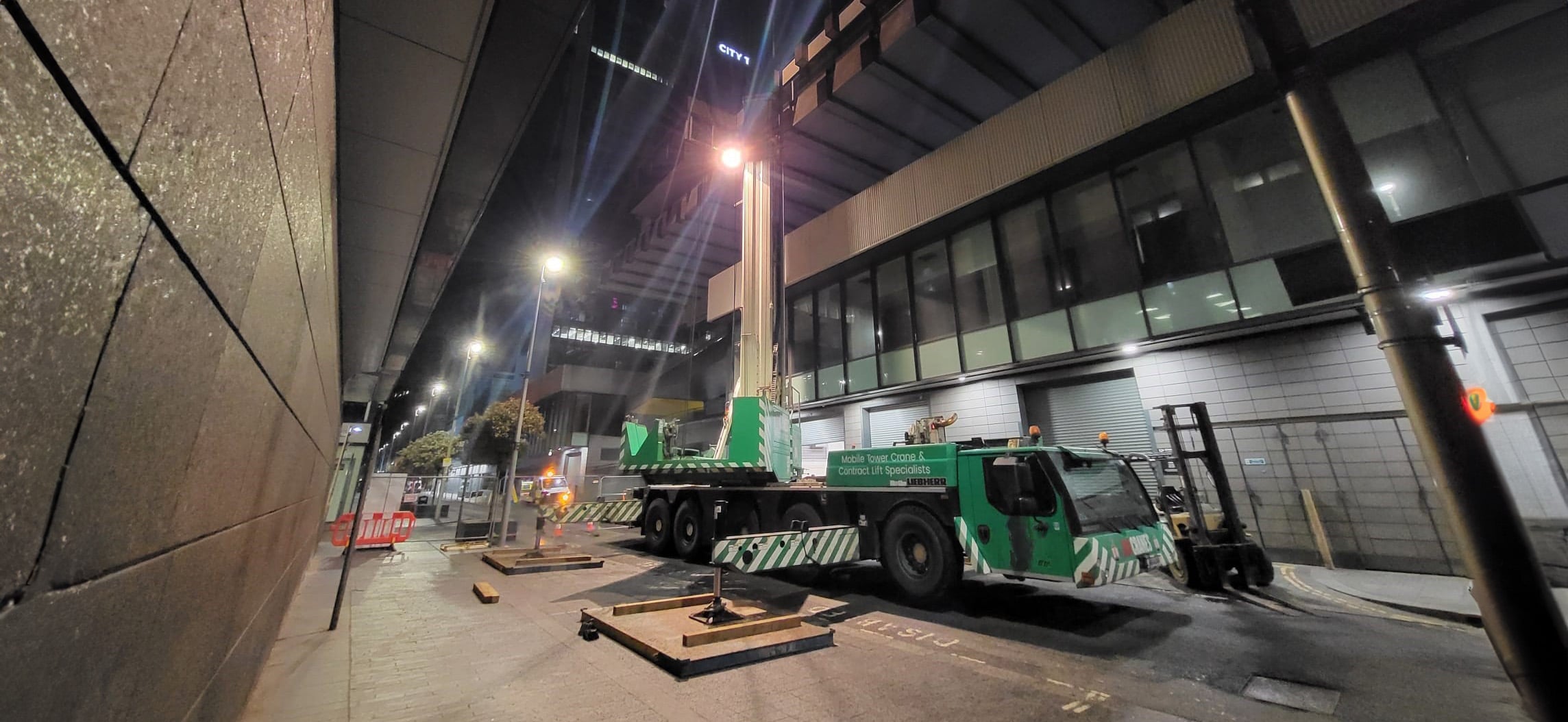
A machinery moving team from Hird has used a mobile self-erecting tower crane to lift air conditioning units onto a hotel roof in the centre of one of the UK’s largest cities.
A road in the centre of Manchester had to be closed during lift to allow the specialist crane to be set up and lift the units at the well-known hotel.
For this reason, the contract lift had to be carried out at night when traffic was at its lightest in city’s usually extremely busy central business district.
The mobile tower crane was needed because of the limited set-up space next to the hotel, the height to which the loads had to be lifted, and the distance the crane was from the where the loads were being set down.
Challenges of crane lifting at night
Hird Director Jason Timmins, who was the appointed person for the project, said: “Working at night in a city centre location creates specific challenges that our machinery moving teams are experienced at dealing with.
“For example, there is an immediate time constraint, as any public space needed for the crane and other equipment usually needs to be reopened in time for use early in the morning.
“Also, despite using lighting rigs, light conditions are often not optimal, with patches of darkness and glare to contend with during a safety-critical process.
“Finally, although the work site is barriered off, there are people out at night in the centre of large cities who present specific risks, to our team’s and their safety, and to the security of our equipment.”


Mobile self-erecting crane selected
Due to the presence of underground services in the space in which the mobile crane needed to be set up, large outrigger pads were used to ensure the crane exerted a maximum ground load of no more than 7.5 tonnes per square metre.
Hird used a forklift to lift the pads, each measuring 3m by 2m and weighing 1400kg, off a transport truck and position them to allow the mobile crane to be set up.
The crane operator then raised the crane’s tower to a height of 37.4m, and extended the boom to 58.5m, ready to start lifting the 21 air conditioning condensers from the delivery lorry and onto the hotel roof.
The Liebherr MK140 mobile self-erecting tower crane selected for the project had a maximum safe working load (SWL) of 8t.
Set up to carry out this particular series of lifts, the crane’s SWL was 1700kg, while each of the air conditioning units weighed 250kg, with an additional 50kg of specialist lifting gear.


Digital images created during Hird’s preparation of the optimal lift plan
Responding safely to lifting challenges
A site survey had identified the precise load set-down point on the hotel roof. The air conditioning engineers moved the units into position while the crane operator and Hird’s lifting team worked together to lift other units, in turn, to the same set-down position.
Jason Timmins said: “The lift went smoothly, not least because, in the planning phase, we always consider a wide range of scenarios. Also, when the lift’s in progress, our teams are experts at responding flexibly and safely to challenges as they arise.
“This was a standard lift project for us, with an intermediate risk score. But it demonstrates the range of specialist cranes Hird can deploy to for any lifting and machinery moving challenges.”
Find out more
Talk to Hird about our national machinery moving and contract lifting service.
Email: [email protected]

