
Meticulous planning prepares way for hospital machinery moving lift

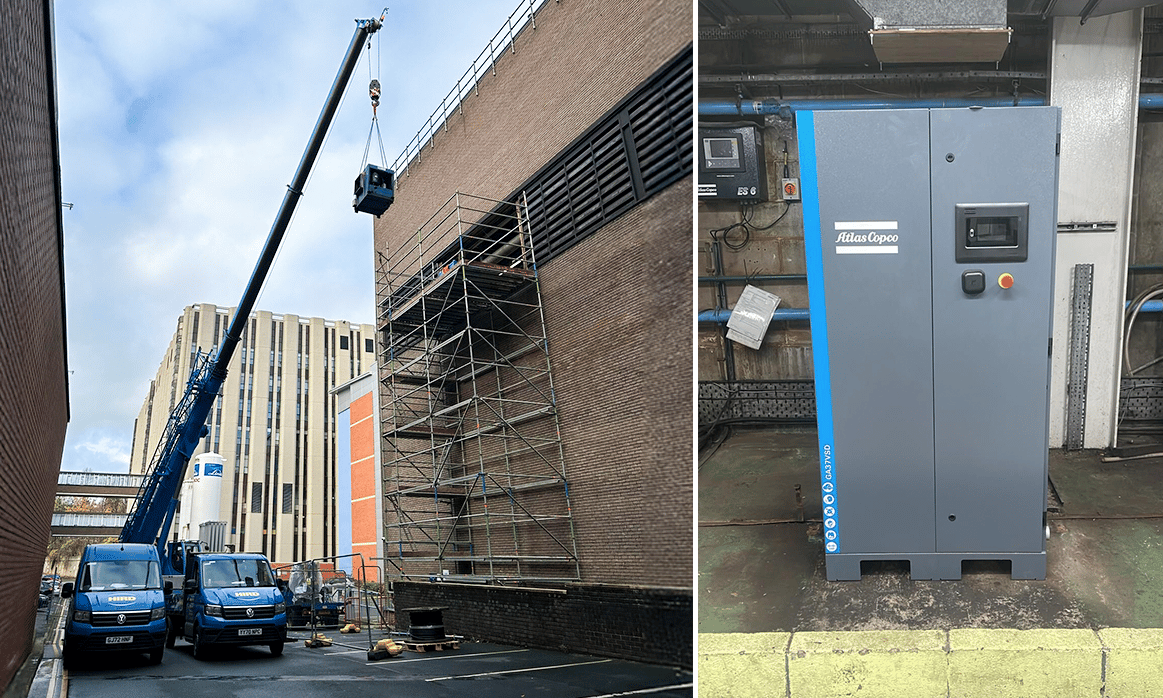
A machinery moving team from Hird has lifted a vital piece of equipment into a machine room at an acute hospital following meticulous planning to ensure emergency helicopters could still land.
The project could only go ahead after Hird also confirmed its mobile crane could be positioned away from the route of a motorway that runs in a tunnel beneath the hospital site, in Leeds, West Yorkshire.
The lift plan, developed during consultations with hospital operational and emergency medical managers, was implemented smoothly, allowing an air compressor to be installed without a hitch.
Detailed planning to avoid helipad disruption
The machinery moving project, carried out at Leeds General Infirmary, in the centre of West Yorkshire’s largest city, was planned by Hird Director and Appointed Person Jason Timmins over several months.
He said: “The lift was quite straightforward. What created the complexity for the project was the need to ensure our lift operation did not disrupt the use of the emergency helipad on a nearby building.
“Due to weight restrictions, we also had to show we could move our mobile crane onto site without driving within 10 metres of the line of a tunnel that takes the A58(M) under the hospital estate.
“We liaised closely with hospital facilities managers, who were very helpful. Over a period of weeks, were able to give all parties the assurance they needed to allow the lift to take place.
“It’s an example of how, on certain occasions, it’s not the lift that’s the challenging element of the project, but the need to take account of site conditions and very legitimate concerns of site users.”


Emergency communication in place
The helipad, used by air ambulances to transport seriously ill patients to and from the hospital, which has a major trauma centre, was located on top of a building around 30m from the lift site.
Hird had to confirm the machinery moving team could lower the mobile crane’s boom within 10 minutes of being alerted that the helipad needed to be used.
An emergency communication system was put in place, in case this needed to happen. In the event, the helipad did not need to be used.
The Hird machinery moving team used the company’s Liebherr LTM 1060 3.1 mobile crane, which has a maximum SWL of 60t, to carry out the lift, needed to replace an ageing air compressor with a new one.
The mobile crane was set up with a boom length of 20.7 metres and working radius of 13 metres.


Equipment lifted in through side of building
In the first of three lifts, a basket of equipment, including a pallet truck and timber blocks, was lifted onto a 11-metre-high scaffolding deck erected to facilitate the project.
This equipment was then moved into the building through an aperture created by the removal of industrial louvres, again to enable the compressor swap.
In the second lift, the redundant compressor, which weighed 600kg, was moved to the aperture using the pallet truck. Machine moving skates were then used to transferred it onto the scaffolding deck, where it was then lifted down with the mobile crane.
In a reverse process, the new compressor, which weighed 400kg, could then be lifted onto the temporary external deck, and moved to its final installation point with the moving skates and the pallet truck.


Find out more
Hird is one of the most experienced national machinery removal and installation specialists in the UK. Its teams work across all sectors, including data centres, factories, dockyards, heavy engineering plants and aerospace sites.


Talk to us about our machinery moving services. We will carry out a free, no-obligation site survey before every lifting project.
Email: [email protected] Telephone : 01482 227333