

Tyres
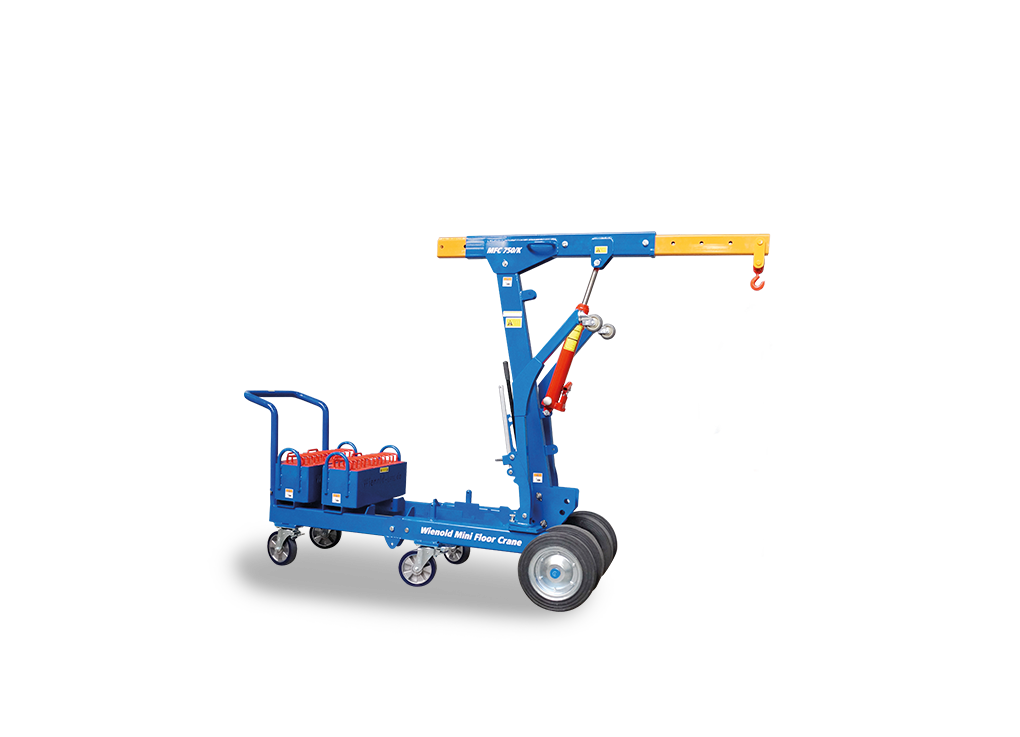
Indoor non-marking tyres are often a standard fit for a counterbalance floor crane. Some models, however, can be fitted with all terrain tyres to improve transport across sites or over obstacles and reduce point loads.
Boom
The boom can be manually extended by hand, to pre-set lengths, determined by the radius the crane needs to be working at.
Counterweights
Counterweights are an essential component of the lift – providing the counterbalance for the load – remember your Newton’s Laws from Physics!
They often come with useful carry handles and stored neatly to the rear of the crane.
When am I used?
The counterbalance floor crane is used where no other overhead lifting points are available to help lift and manoeuvre heavy loads.
Castors
Sturdy swivel castors are fitted for easy manoeuvring across floors. Fully lockable for crane operation.
Ks and K models
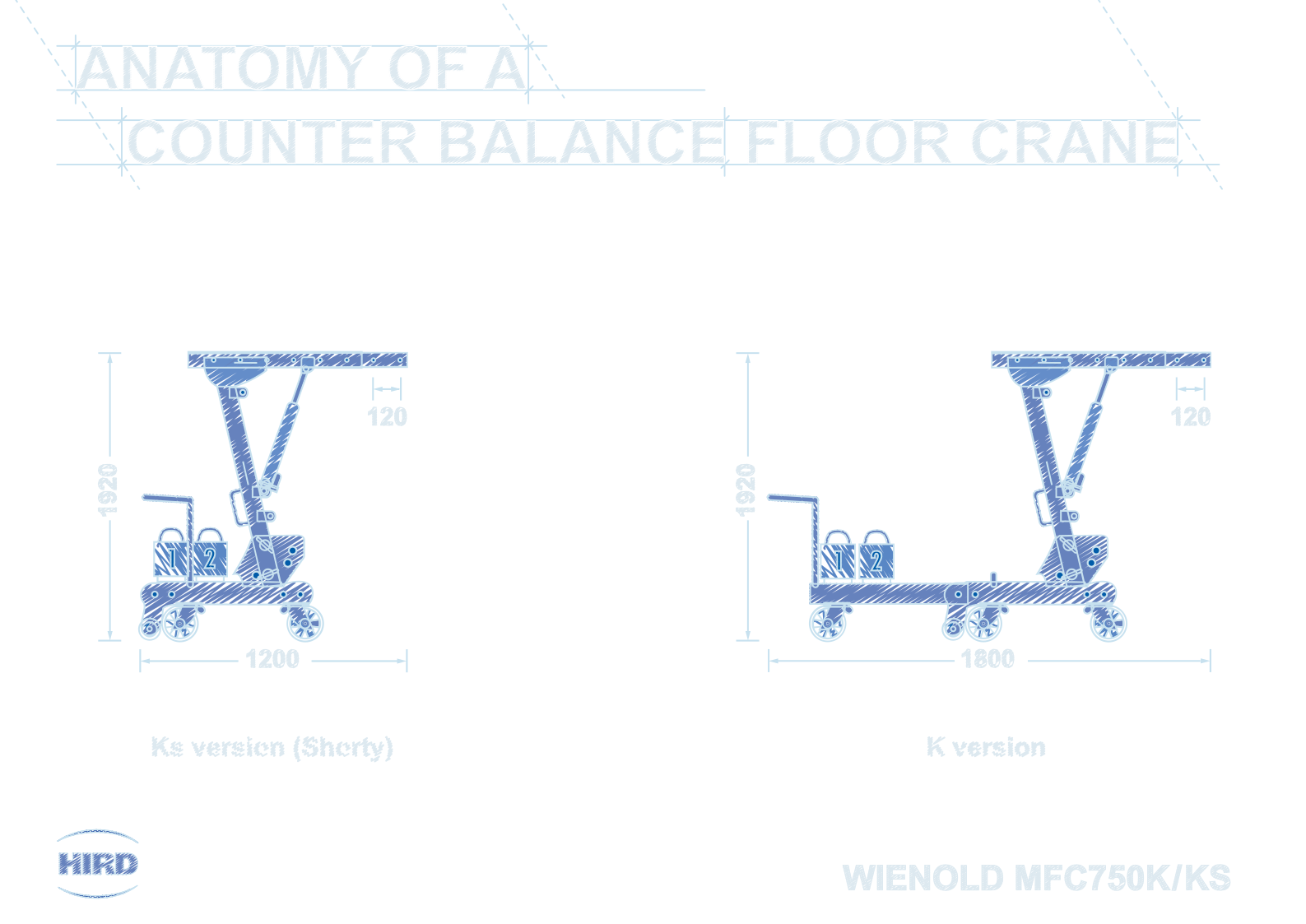
The MFC 750 K is the classic counterbalance floor crane with a high load and high lift capacity
The short version MFC 750 Ks (the S stands for Shorty) has a compact chassis for use where space is limited.
The MFC 750 models use the same multifunction chassis enabling it to be used in both configurations simply by exchanging the boom and weight box.
Hook
Models can be fitted with many attachments, the most popular been a remote control electric hoist for negative lifting duties and glass vacuums.
Safe Working Load + Load Chart
Every Counterbalance Floor Crane must carry two clearly-visible signs. One gives its maximum safe working load (SWL).
The other displays its load chart. A load chart provides data that defines each Counterbalance Floor Cranes capabilities.
Lift ram
A counterbalance crane lift ram is used to lift and lower the boom. It is hydraulically powered.